

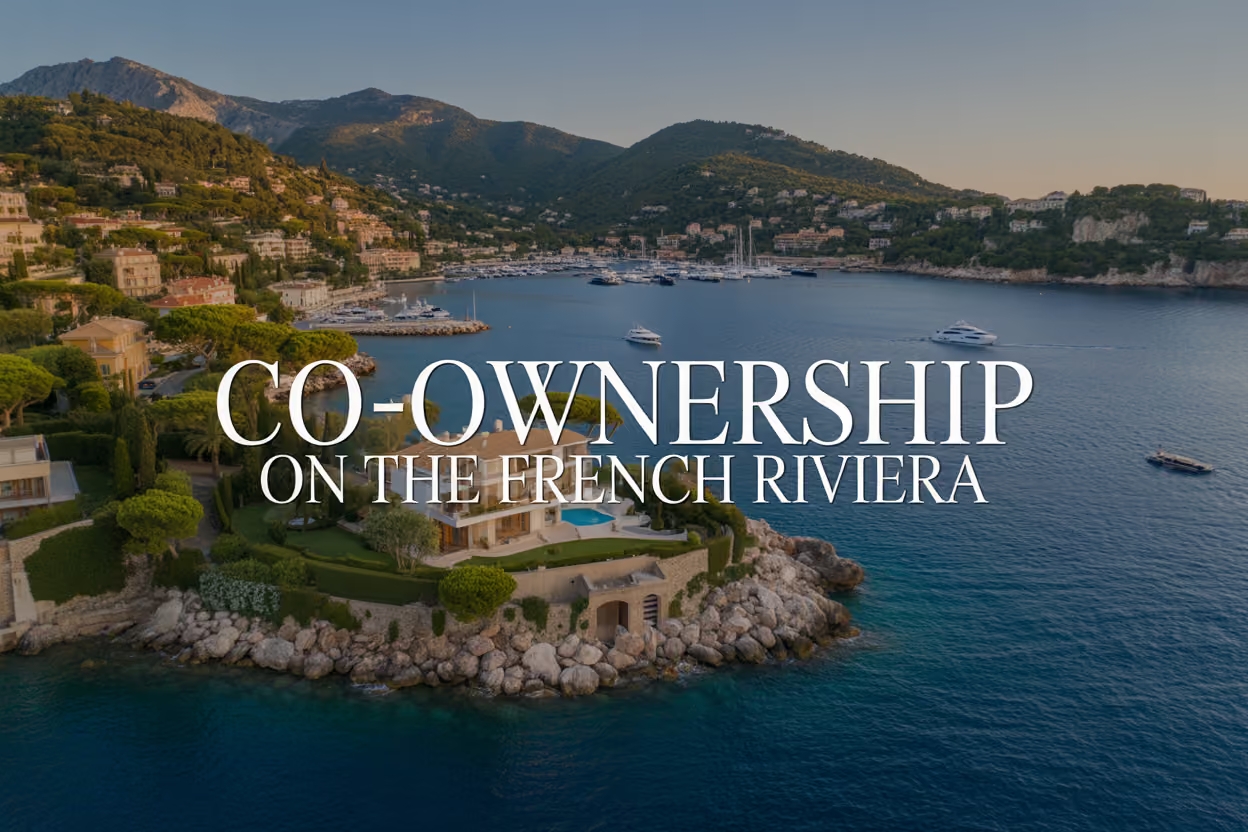
Understanding Co-Ownership on the French Riviera

What Co-Ownership Actually Means for Property Buyers
When you explore co-ownership on the French Riviera, you are entering a model that is fundamentally different from anything the average property buyer encounters in a traditional purchase. At its core, co-ownership — often referred to as fractional ownership in this context — means buying a deeded share of a luxury property, typically a 1/8 interest, held inside a purpose-built LLC alongside up to seven other co-owners.
This is not a loosely worded arrangement or a casual handshake agreement. What you are acquiring is real, recorded property equity registered in your name. Your share appreciates with the underlying property, can be passed on to your heirs, and can be resold through a professional process in approximately one month. Each owner receives around 45 days of personal use per year, allocated through a fair-rotation calendar so that access is distributed equitably across the ownership group.
Everything else — property management, maintenance, taxes, and day-to-day operations — is handled by a professional management team. This means you benefit from the asset without carrying the full weight of ownership administration on your own.
Key characteristics of co-ownership on the French Riviera include:
- Deeded equity stake in the property, registered in your name
- 1/8 fractional share, meaning up to eight co-owners per property
- ~45 days of personal use per year, allocated via a rotation calendar
- Professional management covering maintenance, taxes, and operations
- Transferable and inheritable — your share behaves like real property, not a use-right
How Co-Ownership Differs from Traditional Property Purchase
If you have previously explored french real estate or looked at french property for sale on the Côte d'Azur, you will immediately notice that co-ownership challenges several assumptions built into a standard property transaction.
In a traditional property purchase, you bear the full acquisition cost, pay the complete annual tax burden, manage maintenance either personally or through a property manager at your sole expense, and carry the asset on your balance sheet in its entirety. For a high-specification French Riviera villa, this is a significant financial commitment — one that makes access to prime addresses difficult for many buyers who would otherwise be well-qualified.
Co-ownership restructures all of this. Consider the comparison below:
| Factor | Traditional Purchase | Co-Ownership (1/8 Share) |
|---|---|---|
| Acquisition cost | 100% of property value | ~1/8 of property value |
| Annual running costs | Borne entirely by you | Shared across up to 8 owners |
| Personal use | Unlimited, but often under-utilised | ~45 days per year via rotation |
| Management burden | Your responsibility | Handled professionally |
| Resale process | Full notarial conveyance | LLC membership transfer — faster and lighter |
| Equity ownership | Full deeded title | Registered deeded share |
| Inheritability | Yes | Yes |
The resale distinction is worth pausing on. Because your co-ownership share is held inside an LLC, transferring your interest is a more direct administrative action than triggering a full French notarial conveyance. This is a meaningful practical difference if your circumstances change and you need to exit the investment efficiently.
It is also critical that you understand what co-ownership is not. A timeshare sells you a use-right — access to a property for a defined week or period each year, typically on a fixed-term contract with no meaningful resale value. A co-ownership fractional share sells you a registered equity stake in the property itself. These are structurally opposite products, and confusing them is one of the most common misunderstandings buyers bring to their initial research.
Why the French Riviera Is Ideal for This Buying Model
With this in mind, it is worth examining precisely why real estate france on the French Riviera represents one of the strongest possible contexts for co-ownership as a buying model. The answer lies in a combination of factors that are largely unique to this stretch of coastline.
Climate reliability is the foundation. The Maritime Alps and the Estérel rise sharply behind the Riviera coast and create a sheltered, south-facing slope that holds more than 300 days of annual sunshine on the central Côte d'Azur. The Nice-to-Menton stretch is famous for its January daytime temperatures of 13–15°C — a level of winter-sun reliability that no comparable Mediterranean destination consistently matches. What this means for you as a co-owner is that your 45 days of personal use per year can be spread across seasons with genuine confidence that the climate will deliver.
Supply scarcity is the second structural driver. The 1986 Loi Littoral — France's national coastal-protection law — placed the active coastal margin under strict public-domain regulation nearly four decades ago. The practical effect is that first-line beachfront construction has been capped at the existing footprint along the entire South of France coastline. When you add to this the narrow buildable strip between the Maritime Alps and the sea on the eastern Riviera, the protected Estérel massif west of Cannes, the Massif des Maures behind Saint-Tropez, and the Calanques National Park east of Marseille, you are left with a series of small, finite, well-defined zones within which development can occur. The buildable stock of high-specification French Riviera villas and apartments is, in real terms, no longer growing at the rate of demand in the prime addresses.
For you as a buyer considering french riviera villas through co-ownership, this supply constraint is directly relevant. When you acquire a deeded fractional share of a property in one of these prime locations, you are gaining exposure to an asset class that is, structurally, becoming harder to access — not easier. The Loi Littoral protections that cap new development are the same forces that underpin long-term value in the existing villa stock.
Cultural and historical prestige completes the picture. The French Riviera has held its position as the European prestige Mediterranean default for nearly two centuries — a track record that no manufactured destination can replicate. The depth of infrastructure, the international profile of towns like Cannes, Nice, and Menton, and the cultural weight the region carries give it a resilience that more recently developed coastal markets simply do not possess.
When you combine these three elements — climate reliability, protected supply scarcity, and enduring prestige — the French Riviera emerges as precisely the kind of market where co-ownership delivers its strongest proposition: meaningful equity exposure to an asset you could not realistically access at full cost, in a location where the structural case for long-term value is among the most compelling available in france real estate today.
Key Co-Ownership Structures Available to Buyers

A. Fractional Ownership and How It Works
When you explore french real estate on the Côte d'Azur, one of the first structures you'll encounter is fractional ownership — and understanding how it works is essential before you commit to any purchase.
In fractional ownership, you and a group of other buyers collectively purchase a property, with each person holding a legally defined share proportional to their financial contribution. Unlike a rental arrangement, you actually own a portion of the asset itself. This means your name appears on the title deed, and your stake can appreciate in value, be passed on to heirs, or be sold independently.
Your ownership share is typically expressed as a percentage or fraction — for example, a 25% stake in a French Riviera villa. The rights and responsibilities that come with that fraction, including usage time, maintenance obligations, and rental income distribution, are governed by a co-ownership agreement drafted by a notary and registered with the Land Registry Service.
One of the most important points to understand is decision-making. French law requires that major decisions concerning the property be made by at least a two-thirds majority of the co-owners. This safeguards minority interests and prevents any single owner from making unilateral moves that could affect your investment. Only emergency actions can be taken by one owner acting alone.
Your fractional stake also grants you a right of pre-emption. If another co-owner decides to sell their share, you have the legal right of first refusal to purchase it before it goes to an outside buyer — a protection that helps preserve the group's integrity and your long-term interest in the property.
B. Timeshare vs. Co-Ownership: Knowing the Difference
Many buyers searching for france real estate initially confuse timeshares with co-ownership, but the distinction is critical and could significantly impact both your financial outcome and your legal rights.
Here's a clear side-by-side comparison to help you understand:
| Feature | Timeshare | Co-Ownership (Indivision) |
|---|---|---|
| Ownership of Asset | No — you own usage rights only | Yes — you hold a legal share of the property title |
| Appreciation Potential | Generally none | Yes — your share can appreciate in value |
| Sellability | Extremely limited; often illiquid | You can sell your share, subject to co-owners' right of pre-emption |
| Legal Recognition in France | Limited | Fully recognised under French property law |
| Rental Income | Typically not applicable | Shared among co-owners in proportion to shares |
| Inheritance | Usually not transferable | Can be passed to heirs |
| Decision-Making | Managed by a resort operator | Governed by co-owners through majority rules |
With a timeshare, you are purchasing a block of time — usually one to two weeks per year — in a resort-managed property. You have no ownership stake, no ability to benefit from capital appreciation, and very limited exit options if you wish to leave the arrangement.
Co-ownership, by contrast, treats you as a genuine legal owner. Your financial contribution is reflected in your ownership percentage, and that percentage determines how costs such as taxes, maintenance, and insurance are shared. If you're serious about acquiring real estate france offers as a long-term asset, co-ownership structures are clearly the superior route.
C. SCI (Société Civile Immobilière) as a Buying Vehicle
Now that we have covered the basics of fractional ownership and how it differs from timeshares, it's worth examining one of the most sophisticated and tax-efficient vehicles available for purchasing french property for sale: the SCI, or Société Civile Immobilière.
An SCI is a civil property company that you and your co-buyers establish specifically to hold real estate. Rather than each person owning a share of the property directly, all buyers own shares in the company, which in turn owns the property. This creates a clear legal and administrative structure that can significantly simplify ownership, particularly when you are buying with people who are unrelated to you.
Here are some of the key characteristics and advantages of the SCI structure:
- Simplified decision-making: The SCI's statutes can define how decisions are made — including who has management authority — removing the ambiguity that can arise in a standard indivision arrangement.
- Flexibility in ownership shares: Like indivision, your ownership percentage in the SCI corresponds to your financial contribution at the time of formation. However, the statutes offer more scope to customise rights and responsibilities.
- Ease of transfer: Selling your interest in an SCI can be more straightforward than selling an undivided share in a property, as you are transferring company shares rather than a property title directly.
- Estate planning benefits: The SCI is a widely used vehicle for inheritance planning in France, allowing you to gradually transfer shares to heirs and manage succession in a more structured way.
- Management appointment: Within an SCI, you can formally appoint a manager (gérant), who may or may not be one of the shareholders, to oversee day-to-day operations and decisions related to the property.
It's important to note that the SCI must be drafted and registered formally, and a notary's involvement is essential — especially when real estate is involved. While the initial setup requires more administrative effort than a simple indivision agreement, the long-term governance and flexibility it provides makes it a compelling choice, particularly for investors acquiring french riviera villas and other high-value properties.
D. Private Syndicate Models for Group Buyers
With this in mind, next we'll look at how group buyers can organise themselves through private syndicate models — an approach that builds on the principles of both indivision and SCI ownership but is tailored specifically to groups of investors who may not have a prior relationship with one another.
In a private syndicate model, a group of buyers pools their financial resources to acquire a property that would be beyond the reach of any single investor. Each participant holds a proportional share, and the group is bound together by a carefully structured co-ownership agreement — typically a convention d'indivision — drawn up by a notary.
Key features of private syndicate models include:
- Proportional financial contributions: Each syndicate member's ownership share is directly tied to the amount they contributed toward the purchase. If your contribution is higher, your stake is larger — and so is your share of any rental income or capital gains.
- Clear expense allocation: The agreement specifies how costs such as property taxes, maintenance, insurance, and management fees are divided among members, proportional to their respective ownership shares.
- Appointed management: To avoid the gridlock that can arise from collective decision-making, the syndicate agreement typically designates one member or an external professional as the property manager. This person handles day-to-day operations while major decisions are still subject to the two-thirds majority rule required under French law.
- Right of pre-emption: If any syndicate member wishes to exit and sell their share, the remaining members retain the right of first refusal — meaning the departing member cannot sell to an outside party without first offering their share to the group.
- Fixed-term agreements: The convention d'indivision can be established for a fixed duration of up to five years, with the option to renew. This gives the syndicate a defined lifespan within which members understand their obligations and can plan accordingly.
For buyers exploring french property for sale on the French Riviera, private syndicates can be a particularly attractive route because they allow access to premium assets — a seafront villa near Nice, a hillside estate above Cannes, or a townhouse in Monaco's environs — while distributing both the financial burden and the management responsibility across a trusted group.
The most important safeguard for any private syndicate is a well-drafted co-ownership agreement. This document must clearly outline:
- Each member's ownership percentage
- Rules for property use and scheduling
- Expense-sharing arrangements
- The process for resolving disputes
- Conditions under which a member may exit or the property may be sold
Without this agreement in place, the syndicate defaults to the general rules of indivision under French law — which, while legally sound, may not reflect the specific intentions and preferences of your group. Always engage a notary to draft and register this agreement to ensure full legal enforceability and protection for every member involved.
Top Locations on the French Riviera Worth Investing In

Nice: Affordable Entry Points with Strong Rental Demand
When you begin exploring french real estate on the Côte d'Azur, Nice is often the smartest starting point — and for good reason. As one of the most populated cities in France, Nice combines economic vitality with intense tourism activity, creating a dual-demand market that works strongly in your favor as a co-ownership investor.
What makes Nice particularly compelling is the range of price points available to you. Depending on the neighborhood and proximity to the seafront, you can expect to encounter prices ranging from approximately €5,000 per square meter in standard residential areas to over €10,000 per square meter for properties positioned directly on the waterfront. This spread means that co-ownership structures can give you meaningful access to properties at the higher end of that range without requiring you to commit the full capital alone.
Key advantages Nice offers you as a buyer:
- Dual rental market: Both long-term residential tenants and short-term seasonal visitors drive consistent occupancy
- Strong foreign buyer history: The market is historically sought after by international buyers, supporting property liquidity
- Established infrastructure: As a major urban center, Nice offers reliable services, transport, and amenities that support property value
One important caveat: if you don't know the city thoroughly, navigating the local market without professional guidance can lead to missteps. Working with an experienced local agent is strongly recommended before committing to any co-ownership arrangement here.
Cannes: Prestige Properties with High Seasonal Value
Moving westward along the coast, Cannes represents a different tier of france real estate — one defined by prestige, international visibility, and powerful seasonal demand. The city's global profile, driven by its world-famous film festival and year-round luxury tourism, creates a high-value environment where co-ownership properties can generate exceptional short-term rental returns during peak seasons.
The Cannes market skews toward premium buyers, making it one of the areas on the Côte d'Azur where co-ownership structures are particularly well-suited. Rather than being priced out entirely, co-ownership allows you to hold a share in a prestige property in one of the most recognized addresses in the world. A coastal home in Cannes' La Californie district, listed at €561,000 for a 1/8 share, illustrates the caliber of property this model makes accessible.
FeatureWhy It Matters for Co-OwnersInternational film festivalDrives extreme seasonal demand and premium rental ratesGlobal brand recognitionSupports long-term property value appreciationLuxury buyer baseEnsures a liquid resale market for your co-ownership share
Saint-Tropez: Luxury Co-Ownership Opportunities
If your ambition is to access the very top of the french riviera villas market, Saint-Tropez is where that conversation begins. This is unambiguously a luxury destination, with property values and rental rates that reflect the global elite clientele it attracts throughout the summer season.
For you as a buyer, Saint-Tropez co-ownership is less about affordability and more about access to an otherwise exclusive tier of real estate. The properties here are aspirational assets — commanding significant sums even for fractional shares — but the co-ownership model makes participation realistic for a far wider pool of investors than outright purchase would allow.
What you should keep in mind about the Saint-Tropez market:
- Seasonal concentration: The bulk of rental value is generated during a compressed summer season, so maximizing your occupancy strategy during those weeks is critical
- Long-term appreciation: The consistent demand from ultra-high-net-worth international visitors supports the sustained appreciation of prime assets here
- Prestige co-ownership structures: Given the property values involved, the legal and financial structuring of your co-ownership agreement in Saint-Tropez deserves particularly careful attention
Antibes and Villefranche-sur-Mer: Hidden Gems for Buyers
Now that we have covered the headline destinations, it's worth turning your attention to two locations that offer outstanding investment value without the same level of mainstream visibility: Antibes and Villefranche-sur-Mer.
Both towns are positioned along the coveted first line of the Côte d'Azur coastline, placing them in the category of high-demand, premium-priced coastal french property for sale. Villefranche-sur-Mer in particular, along with neighboring Cap d'Ail and Saint-Jean-Cap-Ferrat, forms part of an in-demand coastal corridor where real estate prices can reach stratospheric levels precisely because supply is tightly constrained.
Here's why these locations deserve your serious consideration:
- Coastal positioning: First-line properties in Villefranche-sur-Mer sit in a market where demand from wealthy insiders remains consistently strong
- Lower profile, high fundamentals: These towns attract serious long-term investors rather than speculative buyers, contributing to market stability
- Co-ownership advantage: The elevated entry prices in these markets make co-ownership one of the few realistic routes for buyers who want genuine coastal exposure without unlimited capital
One important consideration: properties closer to the coastline command premium prices, and the market for non-prime properties in these areas can be less liquid. When you invest here through a co-ownership structure, focus firmly on quality assets — properties with default characteristics have little place in these specific markets.
Monaco Borders: Maximum Value Just Outside the Principality
Previously, I've discussed locations where tourism and lifestyle drive investment value. Monaco operates by a different logic entirely — and understanding this distinction is essential before you make any decisions in this part of the real estate france landscape.
Monaco itself presents a complex picture for buyers. While it is frequently associated with tax advantages, a bilateral agreement between France and Monaco means that French nationals cannot claim the tax benefits that Monegasque legislation might otherwise offer. For foreign investors without specific tax exemption objectives, purchasing directly in Monaco delivers limited financial advantage relative to its extraordinary cost — a single square meter in Monaco costs approximately €40,000, and even a large studio will set you back around €1 million.
With this in mind, the far more strategically sound approach is to focus on the territory immediately bordering Monaco. Towns like Cap d'Ail sit directly adjacent to the Principality and offer you:
| Factor | Monaco | Monaco Border Areas |
|---|---|---|
| Price per sqm | ~€40,000 | Significantly lower |
| Tax benefits (French nationals) | None (bilateral agreement) | Standard French framework |
| Proximity to Monaco | Direct | Immediate walking/driving distance |
| Long-term appreciation | High but entry cost is extreme | Strong, with manageable entry points |
| Co-ownership viability | Extremely expensive even fractionally | Accessible through co-ownership structures |
For large investment sums, the Côte d'Azur — particularly areas bordering Monaco — represents a serious long-term alternative that allows you to deploy significant capital in the medium to long term without excessive financial risk exposure. The combination of location prestige, proximity to Monaco's infrastructure, and more rational entry pricing makes this corridor one of the most strategically interesting zones for co-ownership investment on the entire Riviera.
Financial Benefits That Make Co-Ownership Attractive

A. Significantly Lower Upfront Purchase Costs
One of the most compelling reasons to explore co-ownership when looking at french real estate is the dramatic reduction in upfront purchase costs. When you purchase a sole-ownership property on the French Riviera — one of the most premium real estate markets in the world — you are expected to cover 100% of the asking price, regardless of how many weeks per year you actually use the property. Co-ownership fundamentally changes this equation.
Under a managed co-ownership model, anywhere from two to eight buyers with complementary usage preferences share ownership of a single property. This means you only pay the fraction of the purchase price that corresponds to your intended personal usage. If you share ownership with three other buyers, for example, your upfront cost is reduced to approximately one-quarter of the full market value.
For buyers eyeing french riviera villas or luxury apartments in sought-after coastal towns, this distinction is enormous. Properties in these locations routinely command prices in the high six to seven figures. Co-ownership allows you to access that same premium address, the same architectural quality, and the same prestige — without needing to finance the entire asset on your own. This opens up a tier of real estate france that would otherwise remain out of reach for many buyers, including younger investors and those with strong but not unlimited capital reserves.
Critically, this is not a timeshare or a right-to-use arrangement. Co-ownership represents true, legally registered property ownership. Your share is recorded in the land registry and can be resold, meaning you are building genuine equity from day one.
B. Shared Maintenance and Operating Expenses
Beyond the purchase price, the ongoing cost of maintaining a luxury property on the French Riviera is substantial. When you own a property outright, every euro of operating expense — routine maintenance, property insurance, local taxes, utility bills, cleaning, landscaping, and repairs — falls entirely on your shoulders. With co-ownership, these costs are distributed proportionally among all co-owners, significantly reducing your individual financial burden.
This shared cost structure covers a wide range of recurring expenses:
- Operations and utilities — Costs associated with keeping the property functional year-round
- Maintenance and repairs — Routine upkeep as well as unexpected repair work
- Insurance — Comprehensive coverage for a high-value property
- Local taxes and levies — Applicable charges associated with property ownership in France
- Professional management fees — In managed co-ownership models, a dedicated management service handles everything on your behalf
The last point deserves particular attention. Managed co-ownership platforms provide an all-inclusive management service, meaning you never need to coordinate with service providers, chase contractors, or organize cleaning and turnovers yourself. Everything is handled professionally, so that when you arrive at your property on the French Riviera, all you need to do is enjoy it.
When you compare this model against sole ownership of french property for sale in the same category, the financial efficiency becomes clear. As a sole owner, not only do you absorb 100% of these costs, but you are also managing all of these responsibilities either personally or through a private property manager — which is itself an additional expense. Co-ownership consolidates these functions and distributes the financial weight in a way that is far more sustainable for most buyers.
Here is a simplified comparison to illustrate the difference:
| Expense Category | Sole Ownership | Co-Ownership (1/4 Share) |
|---|---|---|
| Purchase Price | 100% | ~25% |
| Annual Maintenance | 100% | ~25% |
| Insurance | 100% | ~25% |
| Property Taxes | 100% | ~25% |
| Management | Self-arranged or extra cost | Included in managed model |
With this in mind, next, we'll see how co-ownership can also work actively in your favour during the times you are not using the property.
C. Generating Rental Income During Unused Periods
Previously, one of the most frustrating inefficiencies of owning a holiday property was watching it sit empty for most of the year. Research cited in the co-ownership space suggests that sole-ownership holiday homes can sit vacant for as much as 80% of the year — a significant financial waste when you consider the full cost of ownership.
Co-ownership addresses this directly. Because the property is used by multiple owners with complementary usage preferences, overall occupancy improves significantly. The same research indicates that co-ownership has the potential to reduce vacancy rates from 80% down to approximately 40% — a transformative improvement in how effectively your asset is being utilised.
For periods when neither you nor your fellow co-owners are using the property, many managed co-ownership models include provisions for generating rental income. This means your french property for sale investment is not simply a cost centre — it can actively generate returns during your unused periods, helping to offset your share of the ongoing expenses and, in favourable conditions, producing net positive returns.
This dynamic adds an entirely new financial dimension to co-ownership of real estate in france. You are not merely reducing your costs — you are positioning your investment to generate income. For buyers who only plan to use their Riviera property for a defined number of weeks each year, this is a particularly powerful advantage.
Additionally, because managed co-ownership models use sophisticated reservation systems to allocate usage fairly among owners, you retain meaningful access to the property during your preferred times — with data suggesting that up to 75% of desired usage periods can be realised with a single ownership share. You get the lifestyle benefit of a luxury Riviera property, share the costs equitably, and still retain the potential for your asset to generate income on your behalf when you are not there.
Taken together, the financial benefits of co-ownership — lower purchase costs, shared operating expenses, and rental income potential — create a compelling case for buyers exploring france real estate in one of the world's most desirable destinations.
Legal Framework Every Buyer Must Understand

French Property Law and Co-Ownership Rights
Before you commit to purchasing french real estate on the Côte d'Azur, understanding how co-ownership is structured under French law is not optional — it is essential. The French legal system governs co-ownership through a framework that applies to virtually all apartments and, in certain cases, houses and commercial premises alike.
At the heart of French co-ownership law is a fundamental principle: every co-owned property consists of two legally inseparable elements:
- Private areas — the rooms and spaces within your individual lot
- A quota of common areas — expressed as a percentage (most often in thousandths) covering shared spaces such as elevators, green spaces, boiler rooms, and hallways
These two elements together form what is known as an indivisible lot. You cannot own one without the other, and this distinction directly shapes your rights and obligations as a co-owner of france real estate.
All co-owners collectively form what is called the syndicate of co-owners (syndicat des copropriétaires), which has the same legal capacity as a company. This body meets at least once per year in a general assembly to:
- Review and approve annual accounts
- Set the provisional budget for the following year
- Vote on necessary works for common areas
- Renew or replace the property trustee (syndic)
- Elect members of the union council
Decision-making within this syndicate is governed by majority rules, with the law requiring different thresholds depending on the nature of the decision. The most serious decisions require unanimity, while routine adjustments may pass by a simple majority.
For joint ownership under the indivision structure — the most common form of joint ownership in france real estate — decisions concerning the property require agreement by at least a two-thirds majority of co-owners. This is a critical detail if you are purchasing with unrelated partners or as part of a larger investment group.
Drafting a Solid Co-Ownership Agreement
Now that we have covered the statutory framework, the next layer of protection for you lies in the quality of your co-ownership documentation. French law references two key documents you must understand before signing anything.
The Co-Ownership Regulations (Règlement de Copropriété)
Every co-owned building is governed by a set of co-ownership regulations. These regulations are not generic — they are specific to your building and contain:
- General information about the building
- The intended use of each private lot
- Restrictions on activities you may conduct on the premises
For example, if you purchase a unit in a building designated for exclusive residential use, operating a business from your unit will be forbidden. Running a liberal profession may be tolerated, but you must review your specific regulations to confirm this. Simple administrative domiciliation of a sole proprietorship may be permitted if no clients or goods are received on-site, but you should never assume this without consulting the document.
What you must watch out for:
- Restrictions on renting your unit short-term
- Rules around renovations that affect common areas
- Clauses that limit how you can use your french riviera villa or apartment
Even if your building's regulations appear similar to others you have reviewed, peculiarities specific to your building can expose you to legal challenges from other co-owners if ignored.
The Convention d'Indivision (Management Agreement)
If you are purchasing french property for sale alongside other individuals — particularly if you are unrelated — the most appropriate way to manage the property is through a convention d'indivision. This is a formal management agreement that governs how decisions are made, how costs are shared, and how disputes are handled among co-owners.
Without this agreement, you are exposed to the full rigidity of the statutory two-thirds majority rule, which can result in deadlock if owners disagree. With it, you can establish clearer, agreed-upon procedures tailored to your specific situation.
Your notaire (notaire) is the key professional who should assist you in drafting this agreement. Do not proceed without one.
Tax Obligations for Foreign Co-Owners in France
With the legal structure in place, you must also prepare for the tax landscape that comes with owning real estate france. As a foreign co-owner, your obligations differ in important ways from those of a French resident.
When you purchase shares in a property under the indivision structure with different financial contributions from each co-owner, French tax authorities pay close attention to the source of funds. Specifically:
- If co-owners contribute unequal amounts but hold equal shares, the French tax authorities may interpret the difference as a gift, which is subject to French gift tax (droits de donation)
- To avoid this, ensure that any larger contribution is clearly documented in the legal paperwork as a loan, not a gift
This distinction is not merely administrative — it can have significant financial consequences for you if not handled correctly from the outset.
Additionally, modifications to your co-ownership lot — such as dividing a lot into two or combining two lots into one — require a notarial act that amends the co-ownership regulations. These amendments are registered with the Land Registry Service at a set registration fee. Failing to register changes correctly can complicate your tax position and your ability to sell or transfer your share in the future.
Exit Strategies and Reselling Your Share
Previously, I've outlined how you acquire and manage your co-ownership stake — but it is equally important that you plan for how you will exit the arrangement. French law provides specific mechanisms for this, and understanding them upfront will save you considerable time and expense later.
Selling Your Share Under Indivision
Under the indivision structure, you retain the right to sell your individual share of the property. However, before offering your share to any third party, you are legally obliged to grant a right of pre-emption to the existing co-owners. This means your fellow co-owners have the first right to purchase your share before you can sell it on the open market.
Note that this right of pre-emption applies only to sales, not to gifts. If you choose to gift your share to someone, existing co-owners do not have the automatic right to intervene.
Forced Sale Scenarios
In exceptional circumstances, one or more co-owners can demand that the entire property be sold if they believe it is overwhelmingly in the interest of the indivision to do so. This is a last resort mechanism that protects minority interests from being permanently locked into an unworkable arrangement.
However, if co-owners cannot reach an agreement, the matter must be brought before a court. You should be aware that judicial delays in France are significant — it can take up to three years before a hearing even takes place, with rights of appeal available to all parties. If any co-owners cannot be traced, the courts may not be able to proceed at all.
Updating the Co-Ownership Regulations Upon Exit
When you sell your share of french property for sale, the co-ownership regulations may need updating — particularly if your departure involves structural changes to lot arrangements. Any such modifications must be voted on at a general assembly by at least a simple majority of co-owners present or represented, and formally registered with the Land Registry Service.
With this in mind, always factor the potential costs and timelines of your exit into your initial investment calculations. Working closely with a qualified notaire from the very beginning is the most effective way to ensure your exit strategy is as smooth as your entry.
Practical Steps to Secure Your Co-Ownership Property

Finding Reputable Co-Ownership Platforms and Agencies
Now that we have covered the legal framework every buyer must understand, it's time to put that knowledge into action. Your first practical step is identifying trustworthy platforms and agencies that specialize in co-ownership arrangements on the French Riviera.
When evaluating co-ownership platforms, look for those that offer a clear dual-entity structure — specifically, arrangements where the property is held by a French Société Civile Immobilière (SCI) combined with a U.S.-based LLC or similar entity. This structure is particularly valuable because it allows you to navigate the ownership process through laws you're already familiar with, rather than being left to decode complex French administrative requirements entirely on your own.
Key questions to ask any platform or agency before committing:
- Does the platform offer deeded ownership, not merely usage rights?
- Are shares fully transferable, meaning you can sell, gift, or inherit them?
- What legal structure governs the co-ownership — SCI, indivision, or another arrangement?
- Is there a professional management company already in place to handle day-to-day operations?
- What is the minimum investment threshold for their French riviera villas and properties?
Reputable platforms will be transparent about all of these details upfront. If a platform is evasive about its legal structure or ownership documentation, treat that as a significant red flag when searching for french real estate co-ownership opportunities.
Conducting Due Diligence on Properties and Partners
With a platform identified, your next move is rigorous due diligence — both on the specific property and on the co-owners or partners you'll be sharing it with. This step is non-negotiable, particularly because co-ownership under French law creates shared decision-making responsibilities that can significantly affect your experience as an owner.
Reviewing Ownership Documentation
Before signing anything, verify that each co-owner's share is clearly identified in the legal documentation. Under French indivision law, if ownership shares are not explicitly documented, the property is automatically assumed to be held in equal shares — even if some buyers contributed significantly more financially. This distinction matters enormously when it comes to sale proceeds and inheritance planning.
If contributions among co-owners are unequal, make absolutely certain the legal documents reflect this. Where one party has contributed more but equal shares are intended, the documentation should explicitly state that the larger contribution is a loan, not a gift, to avoid complications with French tax authorities around gift tax obligations.
Evaluating the Decision-Making Framework
When you buy into a co-ownership arrangement in France, you're entering a shared governance structure. Under indivision rules, decisions about the property require at least a two-thirds majority of the owners to proceed. This means your ability to make changes, authorize repairs, or agree to sell can depend entirely on alignment with your co-owners.
Before committing, review whether the co-ownership arrangement includes a convention d'indivision — a formal management agreement that governs how decisions are made, how costs are shared, and what happens if an owner wants to exit. This agreement is especially important when the property is shared between unrelated individuals rather than a couple or close family members.
Assessing the Property Itself
For france real estate investments specifically on the Riviera, conduct thorough checks on:
| Due Diligence Area | What to Verify |
|---|---|
| Property title | Clean title with no encumbrances or disputes |
| Existing co-owners | Identity, financial standing, and exit intentions |
| Management company | Track record, fees, and scope of services |
| Usage allocation | Number of weeks per year tied to your ownership share |
| Insurance and tax coverage | Whether shared fees cover these expenses |
Working with a French Notaire to Finalize the Purchase
Previously, we explored the importance of the French legal framework — and the notaire sits at the very center of finalizing any french property for sale transaction, co-ownership included. In France, a notaire is a state-appointed legal officer whose role is mandatory in all property transactions. This is not optional, and you cannot complete your purchase without one.
The Notaire's Role in Co-Ownership
The notaire is responsible for:
- Drafting and authenticating the purchase deed (acte authentique)
- Ensuring minority interests are protected when multiple owners are involved
- Verifying ownership shares are correctly recorded in the documentation
- Guiding you through the sale process, including pre-emption rights that existing co-owners hold if another co-owner wishes to sell their share
One critical detail to understand: if one co-owner decides to sell their portion of the property, the other co-owners hold a right of pre-emption — meaning they must be offered the opportunity to purchase that share first before it can be offered to an outside buyer. Your notaire will manage this procedure on your behalf and ensure all legal notifications are properly handled.
What to Bring to Your Notaire
When you meet your notaire to finalize the purchase of real estate in France through co-ownership, come prepared with:
- Proof of identity for all purchasing parties
- Documentation of each co-owner's financial contribution and agreed ownership percentage
- A copy of any management agreement (convention d'indivision) already drafted
- Evidence of the SCI or LLC structure if applicable to your arrangement
- Funds confirmation for the purchase amount allocated to your share
The notaire will review all documentation, conduct searches on the property, and ensure the transaction fully complies with French property law before the final deed is signed and registered.
Managing the Property Effectively After Purchase
With this in mind, the work doesn't end at the notaire's office. Effective property management after purchase is what transforms your co-ownership investment into a genuinely rewarding experience — whether you're using your allocated weeks on the French Riviera or monitoring its long-term value as france real estate.
Leveraging Professional Property Management
One of the most compelling advantages of co-ownership is that you don't have to manage the property yourself. Professional management companies handle:
- Day-to-day operations including cleaning between stays
- Routine and seasonal maintenance
- Local compliance and regulatory requirements
- Emergency repairs, so you're never scrambling from abroad
This is particularly valuable when you own french riviera villas or luxury apartments far from your primary residence. You can arrive for your allocated weeks and enjoy the property without coordinating logistics or dealing with unexpected maintenance issues.
Understanding Your Usage Rights
Your usage calendar is tied directly to your ownership share. Most co-ownership structures allocate a specific number of weeks per year proportional to the size of your stake. Some arrangements use fixed week assignments for predictable, recurring access, while others employ rotating scheduling systems that adapt to seasonal demand and your personal preferences.
Modern co-ownership platforms offer real-time booking functionality, allowing you to:
- View available dates well in advance
- Book stays ranging from short breaks to extended visits
- Modify or adjust planned stays through digital platforms
Sharing Costs Transparently
Your co-ownership agreement will typically outline how ongoing costs are divided among all owners. These shared expenses generally include:
- Property insurance
- Local taxes and fees
- Major repair and renovation costs
- Professional management fees
Having these costs distributed among multiple owners makes professional-level property management financially viable — something that would be prohibitively expensive if you were bearing the full cost of a sole-owned luxury property on the French Riviera. Your annual expenditure becomes predictable, which is a significant advantage for long-term financial planning when investing in french real estate.
Planning for Ownership Transfers
Even after purchase, it's worth maintaining organized records of your ownership documentation through the SCI or LLC structure. Because co-ownership shares can be sold, gifted, or inherited through the legal entity structure, having clean and current paperwork means any future transfer — whether planned or unexpected — can proceed smoothly without requiring re-titling of the entire property. Keep your notaire informed of any significant changes in your personal circumstances that may affect how your shares are eventually passed on.

Co-ownership on the French Riviera offers you a genuinely compelling path into one of the world's most desirable property markets. You've now seen how the key co-ownership structures work, why locations across the Côte d'Azur hold their value, and how the financial model lets you access luxury real estate at a fraction of the cost of full ownership. You also understand the legal framework that protects your rights — giving you the ability to sell, gift, or pass on your share — and the practical steps that take you from initial interest to signed ownership.
What makes this model work is that it doesn't ask you to compromise. You get deeded ownership, true appreciation potential, professional management, and flexible access to your property — without the full financial exposure or administrative burden of sole ownership. Whether you're drawn to a sea-view villa above Cannes, a pied-à-terre near Nice, or a hillside retreat in the arrière-pays, co-ownership gives you a structured, legally sound way to make it yours. If the French Riviera has been on your radar, this is the moment to move from considering it to acting on it.